
Underground Leak Detection & Repair in Parker, CO
Underground leak work in Parker reads the surface first: greener grass over the sewer run, soft spots above the water service line, soggy patches where irrigation laterals split. Then line tracing and ground microphones pinpoint the leak before the dig.
Locate before excavating.
An underground leak in Parker rarely shows itself in the basement first. The earliest signal is almost always at the surface. A strip of grass that stays greener through August drought. A soft spot you sink into walking the yard. A soggy patch that does not match where the sprinkler heads spray. Reading those surface signals is the first step in narrowing which underground line is the suspect.
Three buried systems serve a typical Parker property. The water service line runs from the Parker Water and Sanitation District curb stop to the house meter. The sewer lateral runs from the house cleanout to the PWSD main connection. The irrigation system carries water from the backflow preventer through valve boxes to laterals across the yard. Each one fails differently, looks different from the surface, and needs different locating gear. Call (303) 552-3896 for dispatch.
How We Detect Underground Leak Detection and Repair in Parker, CO
Detection starts above ground and moves below only when the surface read narrows the field.
Surface mapping covers the yard methodically: greener strips, soft patches, sinkholes, surface water patterns after rain, and any visible discoloration above known line paths. Most Parker lots have the service line entering at the front corner closest to the street. The sewer lateral exits in the same direction. Irrigation laterals fan out from a curb-side or side-yard valve manifold. Knowing the typical paths cuts mapping time significantly.
Line tracing follows the suspect line path with an electronic transmitter and locator. For metal lines (copper service, cast-iron sewer) the transmitter induces a signal through the pipe itself. For plastic lines (PEX service, PVC sewer, PVC irrigation) the tracing follows a tracer wire if one was installed, or runs a transmitter through a snake fed into the line. Locator depth readings translate to a marked path on the yard surface, depth to within an inch in most soil conditions.
Ground microphones pick up the pressurized leak signature on supply or irrigation lines once the path is known. We walk the marked line slowly with the microphone, watching for the audible signature peak. Most leaks locate to within 12 inches of the actual point. Sewer leaks usually do not transmit acoustic signature well; those rely on camera inspection from the cleanout.
Excavation scope follows the located leak point in Parker, CO
Once the leak is located on the surface, repair scope depends on depth, soil type, and what is on top of the line.
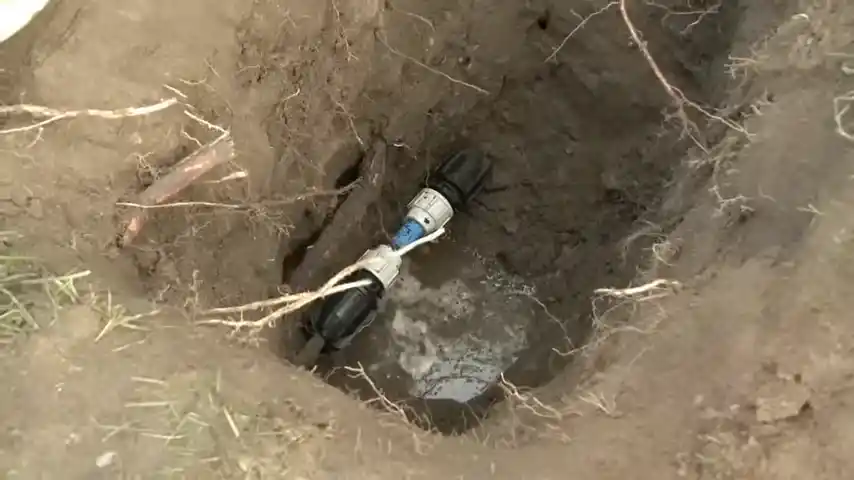
Open trench excavation is the default in Parker's clay-and-bentonite soils. Most underground lines sit 24 to 36 inches deep, above the frost line but below the typical landscape root zone. We dig the smallest access necessary at the marked leak point, usually a 3-by-4 foot pit. Soil type matters: bentonite zones in Crowfoot Valley and Trails at Crowfoot need wider sides on the dig because the clay holds shape poorly and slumps.
Trenchless directional drilling works for full water service line or sewer lateral replacement when the existing line path crosses hardscape. A directional drill bores a new path from one access pit to another, pulling a new line through behind it. Cost runs $1,500 to $4,000 above a trenched replacement, but it saves the driveway, deck, mature landscaping, or hardscape it would otherwise destroy.
Pipe bursting replaces a damaged underground line by pulling a new pipe through the existing line path. The new pipe fractures and displaces the old. Works for sewer lateral replacement on lines deeper than 4 feet where trenching gets expensive. Common call for Mainstreet pre-1980 cast-iron sewer laterals being upgraded.
Yard size and soil type shape the work
Underground leak work in Parker breaks down by lot size and soil. Master-planned cohorts on quarter-acre lots (Stonegate, Stroh Ranch, Cottonwood Parker) have short service lines and tight irrigation runs that locate quickly. Larger lots in Reata Ridge, Salisbury Heights, Hidden River, and Trails at Crowfoot run 75 to 150 feet of service line and several hundred feet of irrigation, which takes longer to map.
Bentonite expansive clay in Crowfoot Valley and Trails at Crowfoot stresses underground lines through moisture-driven movement. Soil dries in summer and contracts; soaks in spring and expands. Lines crossing those zones develop bellies, offsets, and joint failures faster than lines in standard clay loam.
Front Range freeze depth runs about 36 inches in Douglas County. Most lines installed at code-compliant depth (42 to 48 inches for water service) stay below frost. Shallow lines (hose bib supply, exposed risers, near-surface irrigation laterals) freeze and crack on every cold snap when winter lows hit 13 to 22 degrees.
Underground detection $300 to $700. Repair $1,500 to $15,000.
Detection runs $300 to $700 depending on lot size and the number of buried systems that need testing. Repair pricing depends on depth and method: trenched spot repair $1,500 to $4,500, trenchless directional $4,000 to $8,000, full sewer lateral replacement $6,000 to $15,000.
Soft patch or sinkhole forming in your yard?
Locate before you dig. Most Parker underground leaks are spotted by lunchtime.
☎ (303) 552-3896Underground leak questions Parker calls in with
How deep is the typical water line in Parker?
Parker Water and Sanitation District code calls for water service lines at a minimum of 42 inches deep, with most installations between 48 and 60 inches. That keeps the line below the Front Range frost depth of about 36 inches. Older lines installed before current code sometimes sit shallower. We measure depth with the locator before any excavation.
Will you tear up my driveway to fix an underground leak?
Only when there is no other route. Trenchless directional drilling can route a new line under a driveway with two small access pits instead of tearing up the slab. The cost difference is real ($1,500 to $4,000 more) but it usually beats the cost of driveway restoration. We discuss trenched versus trenchless before any digging starts.
I have a wet patch that won't dry. How do I tell which system is leaking?
The patch location relative to known line paths is the first clue. A wet strip following the curb-to-house route usually points at the water service line. A wet patch directly over the marked sewer lateral path points at the sewer. A wet patch in a planted bed often points at the closest irrigation lateral. Line tracing confirms which system is at fault.
Related Leak Services in Parker, CO
Parker, CO & Douglas County Coverage
Underground leak frequency tracks lot size and soil. Large-lot Reata Ridge to bentonite-clay Crowfoot Valley call patterns differ.