
Thermal Imaging Leak Detection in Parker, CO
Wet building materials hold different temperatures than dry materials. A thermal imaging camera maps the temperature differential across walls, ceilings, and floors, revealing hidden moisture patterns. Non-invasive, fast, and complementary to other methods.
Non-invasive scan.
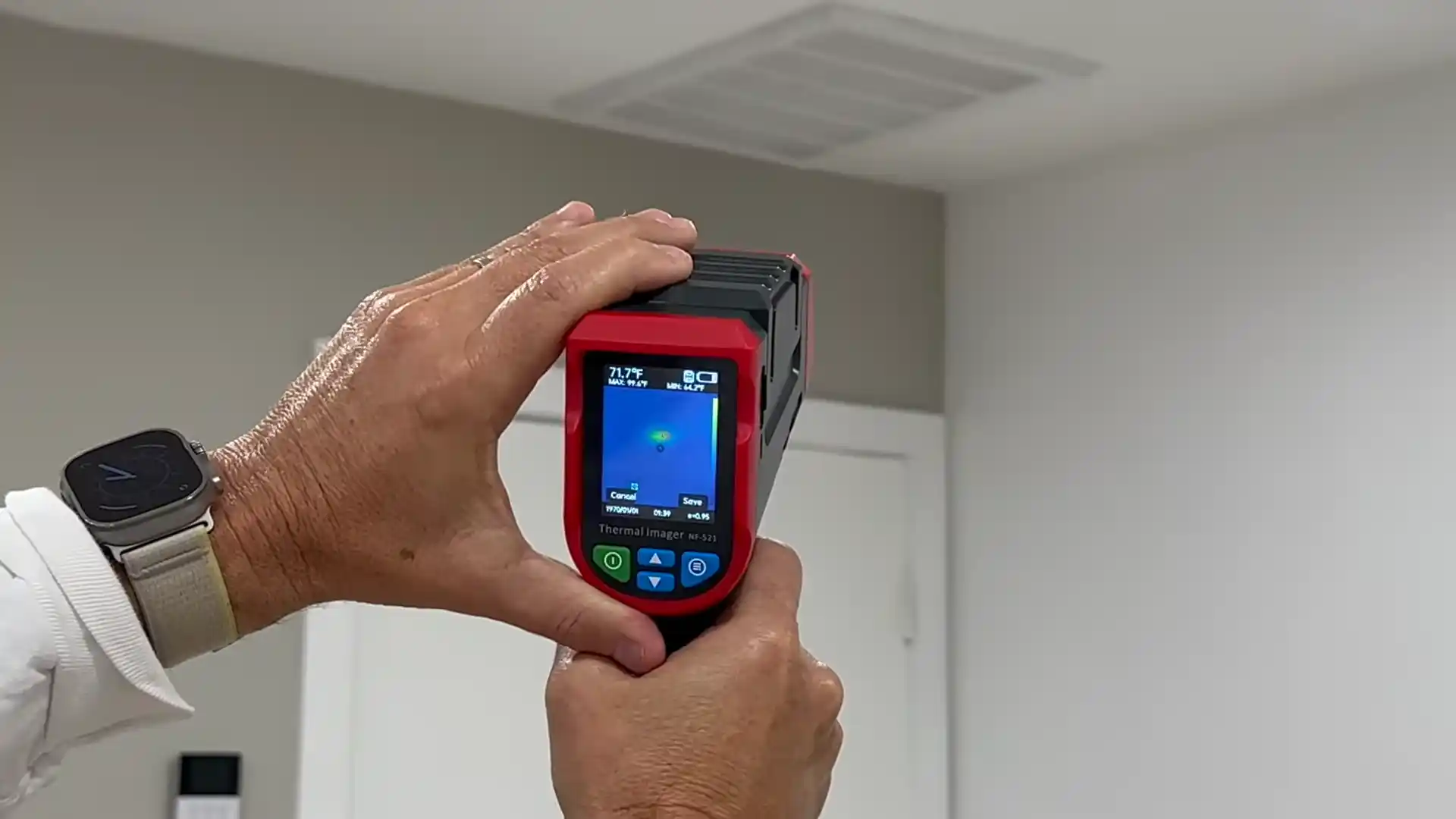
Wet drywall, wet insulation, and wet framing all hold temperature differently than dry materials around them. In summer, wet materials read cooler than dry because evaporation removes heat. In winter, wet materials read warmer because water has high thermal mass and resists temperature change. Either direction, a thermal imaging camera maps the differential as visible color contrast, making hidden moisture patterns appear on a screen.
Thermal methods do not directly find leaks; they map where moisture has accumulated. The map then points us to where to look more carefully with other tools (moisture meter, acoustic listening, dye trace) to confirm the actual source. The advantage is speed and non-invasiveness. We can scan a full ceiling, an entire wall, or a slab in minutes with no demolition. Call (303) 552-3896 for dispatch.
How We Detect Thermal Imaging Leak Detection in Parker, CO
Thermal detection runs a structured scan followed by confirmation with other tools.
Environmental setup establishes thermal contrast conditions. The best images come when there is a temperature difference between inside and outside the building, or between the wet area and the surrounding dry material. Summer afternoons with active HVAC cooling work well; winter mornings with heating system active work well. Mild spring or fall days with little temperature differential sometimes produce weaker images that need supplemental warming or cooling.
Surface scan sweeps the suspect area with the camera. The camera produces a real-time false-color image showing temperature distribution across the scanned surface. Cooler areas appear blue or purple; warmer areas appear yellow, orange, or red. The image gets recorded for later review and for documentation in the leak report.
Pattern interpretation reads the image for moisture-characteristic patterns. Diffuse cool patches usually indicate wet insulation or drywall. Sharp linear cool strips often indicate a pipe behind the wall feeding the moisture. Round cool patches near fixtures often indicate fitting leaks. Each pattern type guides where to look next.
Moisture meter confirmation at thermal-suspect points uses a pin or non-contact moisture meter to read actual moisture content in the drywall or framing. Thermal anomalies can sometimes have non-moisture causes (insulation gaps, HVAC duct routing, sun warming through window); moisture meter readings distinguish actual wet conditions from thermal artifacts.
Source localization with other methods once thermal has identified the wet area. Acoustic listening if a pressurized supply leak is suspected. Dye tracing on plumbing fixtures above the wet area. Camera inspection on drain candidates. Thermal narrows the search; the other methods confirm the source.
What thermal imaging is best for in Parker, CO
Thermal imaging has specific applications where it dramatically outperforms other methods, and others where it adds little value.
Excellent on ceiling stain investigation. A wet stain on a ceiling has water above it somewhere; thermal scanning maps the full wet area, often revealing that the visible stain is only the most-obvious part of a larger problem. Knowing the full wet area saves repair scope misjudgment.
Excellent on whole-wall moisture mapping. Suspected leaks behind a wall benefit from thermal scan to identify the full extent of moisture migration before any drywall gets cut. The scan often shows that the actual wet area is significantly larger or differently located than the visible damage suggests.
Good on slab leak investigation. Slab leaks heat or cool the concrete directly above the leak point. Hot-water-side slab leaks produce a warm spot visible from above. Cold-water-side slab leaks produce a cool spot. Thermal scanning can identify the slab leak's approximate position to within 6 to 12 inches before any other method is applied.
Good on roof-side and exterior intrusion. Water entering through a roof penetration or window flashing travels through framing before becoming visible inside. Thermal scanning from inside maps the moisture path and often reveals the intrusion entry point.
Limited on dry-but-stained surfaces. Old water stains where the moisture has long since dried produce no thermal signal. Thermal needs active moisture to detect.
Limited at minimal temperature differential. Mild days when inside and outside temperatures are similar give weak thermal contrast. We sometimes schedule thermal scans for early morning or late afternoon when the differential is greater.
The total cost saving from thermal imaging often comes from access scope reduction. A confirmed wet area mapped non-invasively means smaller, more targeted access cuts. The thermal scan itself costs $200 to $400; the access cost reduction frequently saves 10 to 20 times that on the overall repair scope.
When Parker calls warrant thermal imaging
Ceiling-leak calls across master-planned cohorts (Stonegate, Stroh Ranch, Idyllwilde, Cottonwood Parker, Bradbury Ranch, Lincoln Creek, Reata Ridge, Hidden River) almost universally benefit from thermal scanning. Two-story homes with upstairs bathrooms over downstairs living spaces generate steady ceiling-leak call volume; thermal scanning maps the moisture before any ceiling demolition begins.
Slab leak calls in 1990s and 2000s master-planned slab-on-grade homes (Canterberry Crossing, Stroh Ranch, parts of Stonegate, mid-2000s Bradbury Ranch) often combine thermal scanning with acoustic methods. Thermal narrows the approximate slab area; acoustic pinpoints within that area; jackhammer access then opens the smallest possible footprint.
Pinhole-leak investigations in The Pinery 1970s cohort and the 1990s master-planned wet-wall cohort use thermal scanning to map the moisture extent before opening walls. Many calls reveal that the wet area is several feet from where the visible damage suggested, which changes both the access plan and the repair scope.
Exterior intrusion calls in bentonite zones (Crowfoot Valley, Trails at Crowfoot, Hidden River) sometimes use thermal scanning from inside to identify where exterior water has migrated through framing. The scan often reveals previously unseen moisture paths that affect the remediation strategy.
Best-condition thermal scans happen on summer afternoons with active AC and winter mornings with active heat. Seasonal extremes produce the strongest temperature differentials.
Thermal imaging $200 to $500.
Single-area thermal scan $200 to $300. Whole-home thermal survey $400 to $500. Detection cost typically folds into the repair when we proceed on the same visit. The cost savings from reduced access scope on the underlying repair usually justify thermal investment 10 to 20 times over.
Hidden moisture you suspect but cannot see?
Non-invasive thermal scan maps the wet area before any demolition.
☎ (303) 552-3896Thermal imaging questions Parker calls in with
Does thermal imaging really show water through walls?
Yes, indirectly. Thermal imaging shows temperature differences across the wall surface; water inside the wall changes the surface temperature compared to dry areas around it. The image does not literally show water but does show where water is affecting the temperature. Confirmation with a moisture meter at the thermal anomaly distinguishes between actual moisture and thermal artifacts from other causes.
Can thermal imaging detect a leak if the water has dried?
No. Thermal imaging requires active moisture to produce a temperature differential. Long-dry water stains produce no thermal signal. If the original source has stopped leaking and the materials have dried, thermal scanning will not show anything. Active or recent leaks (within 24 to 48 hours of moisture exposure) read clearly; older dried damage requires different diagnostic approaches.
Is thermal imaging just for plumbing leaks?
No. Thermal imaging applies to any moisture-related building issue: plumbing leaks, exterior water intrusion, roof leaks, HVAC condensate problems, foundation seepage, and insulation gaps that allow conditioned air to escape. The method is general-purpose for any thermal anomaly, which means a thermal survey often reveals multiple issues beyond just the original leak suspect.
Related Leak Services in Parker, CO
Parker, CO & Douglas County Coverage
Thermal imaging benefits most ceiling-leak, wall-leak, and slab-leak calls across all Parker neighborhoods.