
Ceiling Leak Detection & Repair in Parker, CO
A wet ceiling stain in Parker is a symptom, not a source. The diagnostic job is tracing upward to find where the water actually came from: a bathroom above, a wall-cavity supply line, a roof penetration, or an HVAC condensate line.
Source-traced same-day.
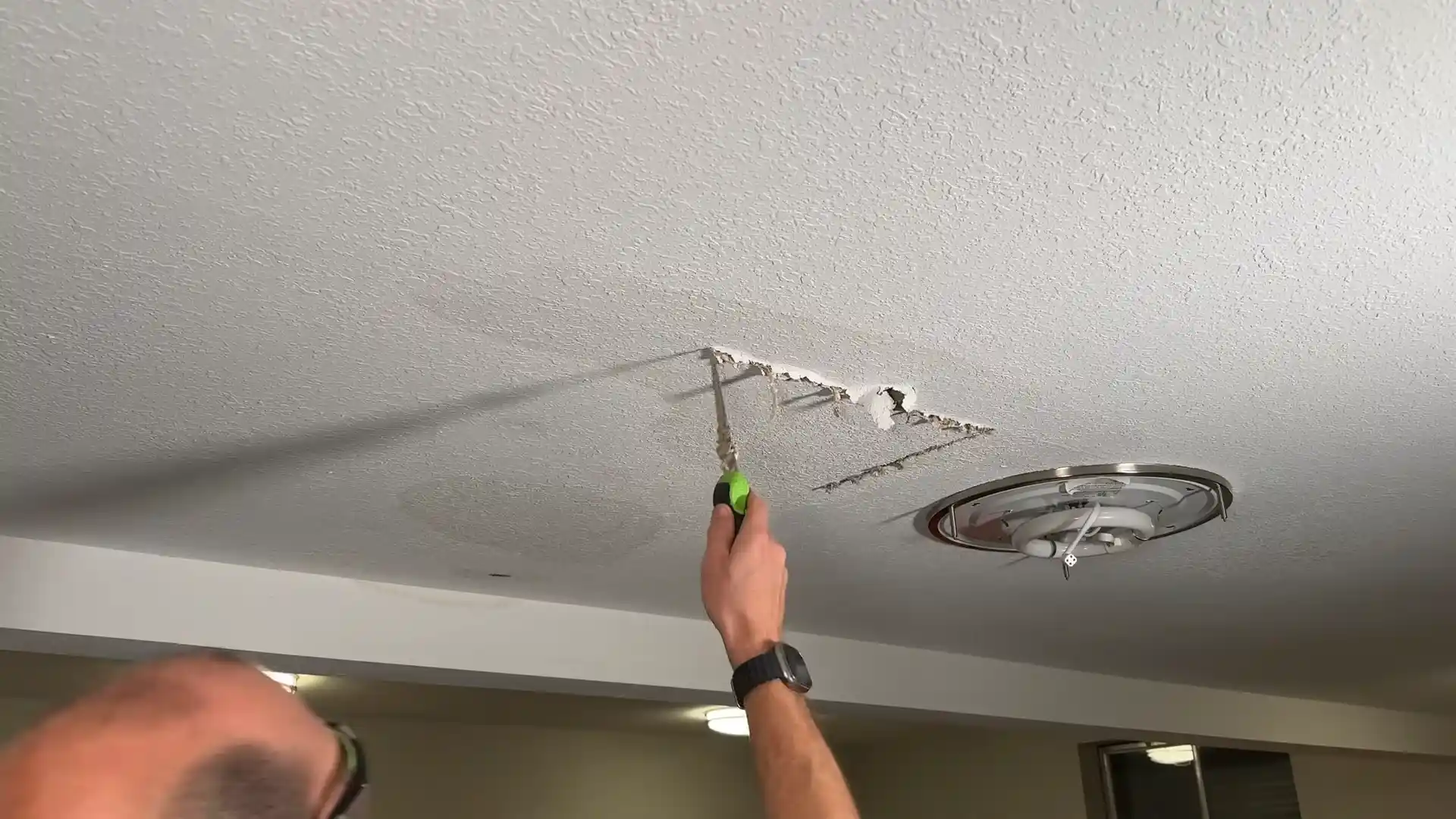
A wet ceiling stain in a Parker home almost always traces back to one of five sources upstairs. A bathroom fixture (toilet, tub, shower, or sink) directly above the staining. A supply line running through an upstairs wet wall. A roof penetration where vent stacks, skylights, or HVAC equipment punctures the membrane. An HVAC condensate line that backed up or cracked. A laundry hookup on an upper floor in newer builds.
Tracing back from a ceiling stain to the actual source matters. The repair scope differs by a factor of ten between the cheapest source (a $30 condensate line fitting) and the most disruptive (a major roof or wet-wall repair). The earlier the source is identified, the smaller the access cut into the ceiling needs to be. Call (303) 552-3896 for dispatch.
How We Detect Ceiling Leak Detection and Repair in Parker, CO
Detection starts at the stain and moves upward in a methodical sequence.
Stain mapping goes first. We measure the extent of the wet area on the ceiling and check moisture readings around the perimeter. The shape often points at the source. Round stains usually trace to a single drip point above. Long stripes trace to a leaking line that runs parallel to the staining. Corner staining points at a roof or exterior wall penetration.
Upstairs fixture survey identifies what is directly above the staining. Most master-planned Parker homes (Stonegate, Stroh Ranch, Cottonwood Parker, Bradbury Ranch, Lincoln Creek) stack fixtures vertically: an upstairs master bathroom often sits over a downstairs powder room or kitchen. Bathroom fixtures are the most common ceiling-leak source.
Fixture flow testing isolates each candidate upstairs fixture in turn. We run each fixture for 60 seconds while watching the ceiling moisture readings. The fixture that worsens the moisture reading is almost always the source. This single test resolves a large share of Parker ceiling-leak calls.
Wet-wall and roof inspection when no upstairs fixture explains the leak. Pinhole leaks in copper supply lines running through interior wet walls present as slow ceiling staining without any fixture connection. Roof penetration failures present after rain events. Each requires different access work to confirm.
Repair scope routes to the source category in Parker, CO
Once the source is identified, the repair follows the source-specific scope. The ceiling itself usually needs drywall patching, possibly insulation replacement, and texture matching.
Bathroom-fixture source repairs follow the toilet, sink, tub, or shower playbooks. Costs span $120 (supply line) to $5,000 (shower pan replacement). The ceiling drywall patch adds $300 to $700 including texture and paint matching.
Wet-wall supply line source requires opening the wall at the located leak point, replacing the failed section (usually a pinhole on copper), and patching both wall and ceiling drywall. Cost runs $600 to $1,800 including access and patch work. Common in Parker's 1990s and early-2000s master-planned cohorts where wet-wall copper is at the pinhole-failure window.
Roof penetration source requires coordinating with a roofing contractor for the membrane repair. Plumbing scope on these calls usually covers the vent stack boot or flange. Roofing work is a separate trade. Ceiling drywall repair runs $400 to $1,200 depending on the extent of water damage.
HVAC condensate source repairs the condensate line, drain pan, or pump. Cost $150 to $500 plus ceiling drywall work.
Ceiling drywall and texture work on Parker homes varies by the original texture style. Knockdown texture (most master-planned cohorts), orange peel (1990s phases), and smooth ceiling (Pinery 1970s and some newer luxury builds) each match differently. We work with restoration contractors when ceiling damage exceeds a single access patch.
Two-story Parker home ceiling-leak patterns
Two-story master-planned homes built between 1995 and 2015 generate most Parker ceiling-leak calls. Stonegate, Stroh Ranch, Idyllwilde, Canterberry Crossing, Cottonwood Parker, Bradbury Ranch, Lincoln Creek, Reata Ridge, Trails at Crowfoot, and Hidden River all have substantial two-story inventory with stacked bathroom designs. The upstairs master bath sits directly above the downstairs kitchen or living space on a majority of these floor plans.
Parker Water and Sanitation District's 9.2-grain hardness drives copper supply failures in the 1990s and early-2000s cohorts, which is the primary wet-wall pinhole source feeding ceiling leaks now. The Pinery and Pine Lane Estates owners face the same risk earlier because well hardness can run past 17 grains per gallon.
The Pinery 1970s cohort has fewer two-story homes (the original development was primarily ranch-style or split-level), so ceiling leaks are less common there. When they occur in Pinery, they typically trace to the bath above the basement or to copper pinholes in wall-cavity supply.
Ceiling leak detection $250 to $500. Repair varies by source.
Detection $250 to $500. Source-specific repair pricing: bathroom fixture $120 to $5,000, wet-wall supply repair $600 to $1,800, roof penetration coordinates with roofing contractor, HVAC condensate $150 to $500. Ceiling drywall patch and texture matching $300 to $1,200 depending on damage extent.
Brown stain or wet spot on a ceiling?
Source-trace identifies the upstairs origin on the first visit.
☎ (303) 552-3896Ceiling leak questions Parker calls in with
How long has the leak been happening if I just noticed the stain?
Most ceiling stains in Parker reflect 2 to 12 weeks of slow leaking before becoming visible. Drywall absorbs water for a while before staining shows; insulation can hold significant moisture without external signs. The exception is a major sudden leak (burst pipe, overflow) which appears within hours. The slow accumulation matters because longer leaks usually mean larger soaked drywall and possibly mold growth in the ceiling cavity.
Will you cut into the ceiling to find the source?
Only after upstairs source-trace has narrowed the suspect to a specific point. Ceiling access cuts are typically 12-by-12 inches at the confirmed source point, not larger exploratory openings. The detection work upstairs usually identifies the source without any ceiling cutting; the cut only happens during repair if the access requires it.
Is mold a real concern in a Parker ceiling leak?
Yes if the leak has been ongoing for more than 2 to 3 weeks. The combination of trapped moisture in insulation and drywall plus enclosed framing space creates mold-favorable conditions. Front Range climate is generally dry, which slows mold growth compared to humid markets, but it does not prevent it. Visible discoloration, musty smell, or extensive wet drywall calls for a mold assessment before drywall repair starts.
Related Leak Services in Parker, CO
Parker, CO & Douglas County Coverage
Ceiling leak prevalence tracks two-story master-planned construction. Pinery ranch-style has different patterns.