
Trenchless Leak Repair in Parker, CO
Trenchless repair replaces or rehabilitates a buried line without trenching the whole length. Pipe bursting pulls a new line through the old. CIPP lining cures a new pipe inside the existing one. Directional drilling installs new line on a fresh path. The yard mostly stays intact.
Yard stays intact.
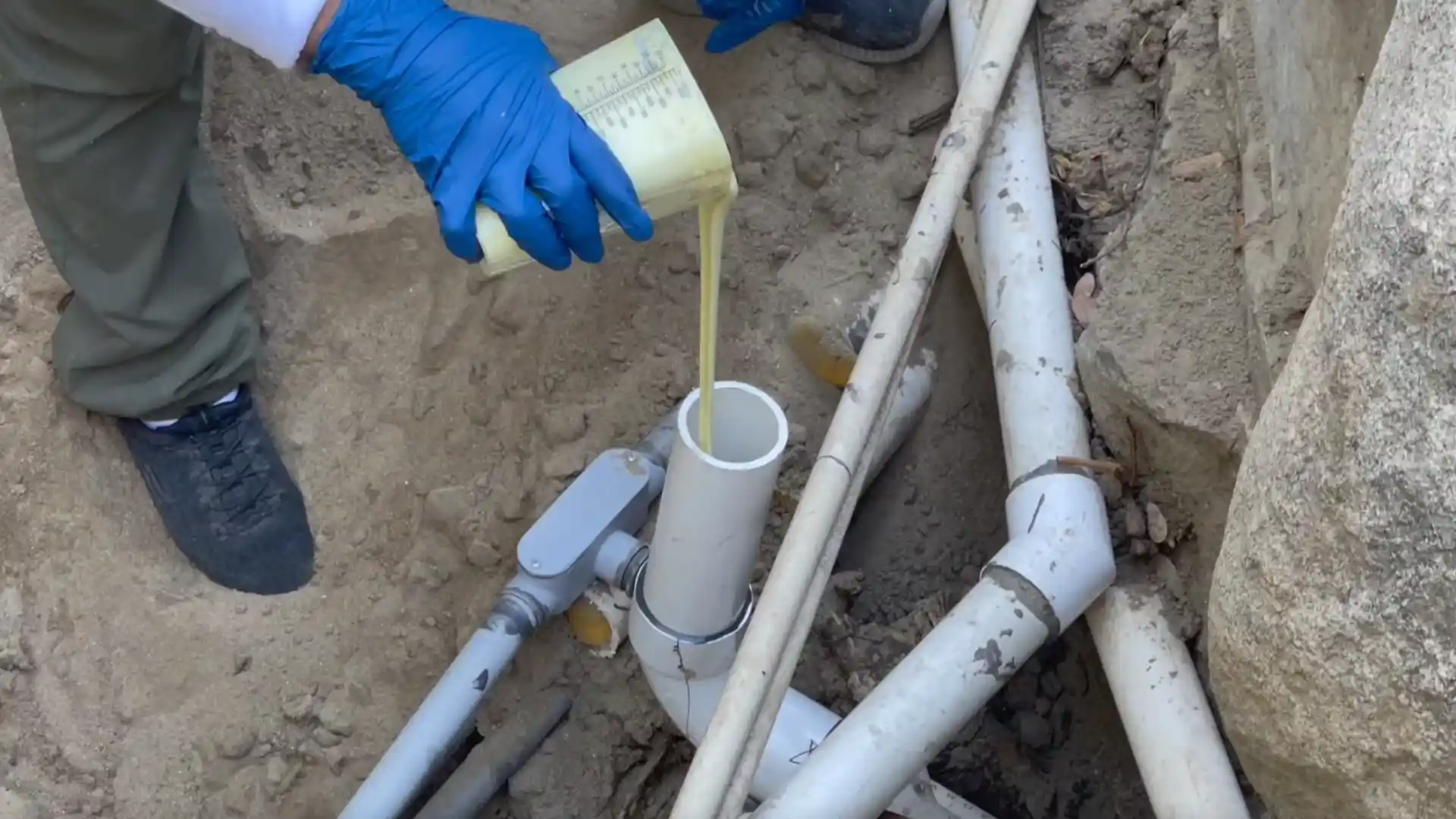
Trenchless repair rehabilitates or replaces a buried line through small access pits at each end rather than a continuous open trench along the entire length. Three main techniques cover most situations. Pipe bursting fractures the old pipe outward while pulling a new pipe through the same path. Cured-in-place pipe lining (CIPP) inserts a resin-saturated liner into the old pipe and cures it in place to form a new pipe inside the old. Horizontal directional drilling bores a new path and installs fresh line where the original cannot be reused.
The value is preservation of the surface. A traditional trench to replace a 60-foot sewer lateral might open a 60-foot strip of yard, driveway, and landscaping. Trenchless replacement of the same lateral needs an access pit at each end, perhaps 3 by 4 feet each, and pulls the new line through underground. Mature landscaping, hardscape, and even building structures over the line path stay intact. Call (303) 552-3896 for dispatch.
How We Detect Trenchless Leak Repair in Parker, CO
Trenchless projects begin with assessment, then proceed through the chosen technique. The method selection depends on line condition and material.
Pre-work line assessment uses camera inspection and sometimes sonar to evaluate the existing line condition. The assessment determines which technique fits. CIPP lining requires a mostly-intact host pipe. Bursting handles collapsed or severely degraded lines. Directional drilling installs a new path when the existing line cannot be reused at all.
Access pit excavation opens small pits at the entry and exit points of the line section being repaired. Typical pits are 3-by-4 feet, located at the line's accessible ends (near the building foundation and at the connection to the main). These pits are the only significant excavation in the project.
CIPP lining execution inserts a felt or fiberglass liner saturated with epoxy resin into the host pipe. The liner inflates against the pipe walls and cures with hot water, steam, or UV light. The cured liner forms a new structural pipe inside the old one. Total downtime is typically 4 to 8 hours; the line returns to service the same day.
Pipe bursting execution for line replacement pulls a bursting head through the old pipe. The head fractures the old pipe outward into the surrounding soil while simultaneously pulling a new HDPE or PVC pipe into the cleared path. The new pipe is full-diameter (sometimes larger than the original). Total project time runs 1 to 2 days.
Directional drilling execution bores a new path using a steerable drill head, then pulls new line through the bored path. Used when the original line path cannot be reused, when routing around obstacles, or when installing entirely new service. Project time runs 1 to 3 days depending on length and conditions.
When trenchless beats open-trench in Parker, CO
Trenchless is not always the right choice. The decision compares trenchless cost against open-trench cost including surface restoration.
Strong case: hardscape or landscaping over the line. When the line runs under a driveway, patio, mature landscaping, or hardscape, trenchless preservation of those surfaces usually justifies the technique. The avoided restoration cost (driveway replacement, landscape restoration) often exceeds the trenchless premium.
Strong case: line under a structure. Lines running under a building addition, a deck, or a permanent structure cannot be open-trenched without removing the structure. Trenchless techniques reach these lines through access pits at the structure edges.
Strong case: long runs. The longer the line, the more surface an open trench disturbs and the more trenchless saves. Sewer laterals and water service runs over 40 feet usually favor trenchless on restoration-cost grounds.
Material and condition factors. CIPP lining requires a host pipe in lineable condition. Severely collapsed lines need bursting or directional drilling instead. Cast iron, clay, PVC, and other materials each have trenchless compatibility considerations the assessment addresses.
Trenchless pricing in Parker: CIPP lining $80 to $250 per foot, pipe bursting $80 to $200 per foot, directional drilling $100 to $300 per foot. A typical 50-foot residential sewer lateral runs $4,500 to $12,000 trenchless versus $6,000 to $15,000 for open-trench with full hardscape restoration, depending on what surfaces the open trench would disturb.
Where trenchless makes sense in Parker
Master-planned cohorts with mature landscaping and hardscape (Stonegate, Stroh Ranch, Cottonwood Parker, Canterberry Crossing, Bradbury Ranch, Lincoln Creek, Reata Ridge, Hidden River) are prime trenchless candidates. Sewer laterals and water service lines running under established lawns, driveways, and patios benefit from trenchless preservation of those surfaces.
The Pinery 1970s cohort and pre-1990 Downtown Parker homes with aging cast-iron or clay sewer laterals are frequent trenchless rehabilitation candidates. CIPP lining rehabilitates these decades-old laterals without disturbing the mature landscaping that has grown in over 45-plus years.
Bentonite expansive clay zones (Crowfoot Valley, Trails at Crowfoot, eastern Parker) put stress on buried lines through soil movement. When these lines fail, trenchless replacement with flexible HDPE via pipe bursting provides a line better able to handle the soil dynamics than the original rigid pipe.
Front Range freeze depth and the deep burial of water service lines (48 to 60 inches below frost) make open-trench excavation of water service particularly disruptive. Directional drilling installs replacement water service at proper depth without the wide trench an open excavation requires. Equestrian outskirts (Franktown, Sedalia, Elizabeth) with long service runs realize the largest trenchless savings.
Trenchless repair $80 to $300 per foot.
CIPP lining $80 to $250 per foot. Pipe bursting $80 to $200 per foot. Directional drilling $100 to $300 per foot. A typical 50-foot residential sewer lateral runs $4,500 to $12,000 trenchless. Access pit excavation and connection work included; surface restoration at the small pits only.
Failed buried line under your yard or driveway?
Trenchless replacement through access pits. Mature landscaping and hardscape stay intact.
☎ (303) 552-3896Trenchless repair questions Parker calls in with
Is trenchless repair as durable as a full pipe replacement?
Yes, often more durable. Pipe bursting installs brand-new full-diameter HDPE or PVC pipe, which is as good as or better than a conventional replacement and more flexible for soil movement. CIPP lining creates a continuous jointless pipe inside the old one, eliminating the joint failures that affect segmented pipe. Both techniques carry warranties comparable to or exceeding open-trench replacement. The trenchless designation refers to the installation method, not a compromise in the result.
Will trenchless work on my collapsed sewer line?
Pipe bursting can, CIPP lining cannot. CIPP lining requires a mostly-intact host pipe to line inside of; a fully collapsed line has nothing to line. Pipe bursting fractures and replaces the collapsed line entirely, so it works even on severely degraded or collapsed pipe. The pre-work assessment determines which technique fits your line's actual condition. Collapsed lines usually go to pipe bursting or, where the path cannot be reused, directional drilling.
How much yard disruption is there really?
Minimal. Trenchless work needs an access pit at each end of the line section, typically 3-by-4 feet each. For a sewer lateral, one pit is near the house foundation and one is at the connection to the city main. The line between those pits stays underground and untouched. Compared to an open trench running the full line length, the disruption is a small fraction. The two access pits get backfilled and restored after the work.
Related Leak Services in Parker, CO
Parker, CO & Douglas County Coverage
Trenchless value is highest where mature landscaping, hardscape, or structures cover the line path.