
Hose Bib Leak Detection & Repair in Parker, CO
Hose bibs in Parker get destroyed by Front Range cold snaps every winter. Single-digit lows split the internal stem or freeze water trapped in the wall stub. Spring service calls for hose bib leaks are the most predictable plumbing pattern in the area.
Spring service standard.
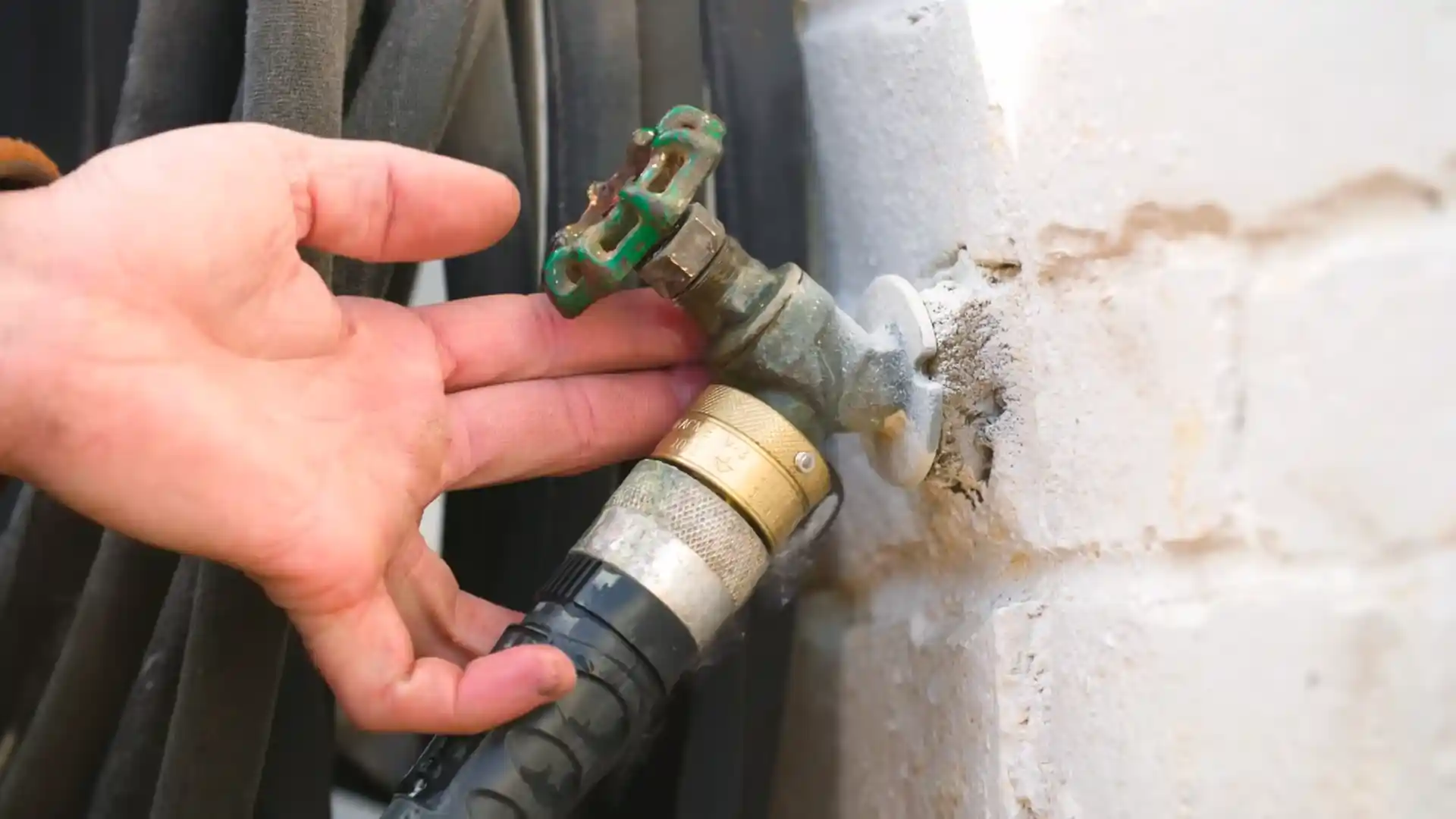
Front Range cold snaps make hose bib failures predictable. Single-digit overnight lows freeze water trapped in the spigot stem or in the supply stub running through the exterior wall. The freeze splits the internal stem, the wall stub, or the supply line just inside the wall. The failure usually shows in spring when the temperature climbs and the water finds the crack. The leak appears either through the spigot body or down through the wall cavity into the basement or crawl space below.
Two hose bib construction styles dominate Parker homes. Standard hose bibs have the shutoff valve near the spigot itself, leaving water in the entire stem exposed to freezing. Frost-proof spigots have a long stem running through the wall to a shutoff valve inside the heated space; properly drained, frost-proof spigots resist freezing far better. Both types still fail in Parker conditions, just at different rates. Call (303) 552-3896 for dispatch.
How We Detect Hose Bib Leak Detection and Repair in Parker, CO
Detection usually wraps in 15 to 25 minutes once we are on-site.
External spigot inspection looks at the visible body, the handle, and the connection point on the exterior wall. Active drips from the spigot body itself usually indicate stem packing failure or a cracked internal stem. Drips from the wall around the spigot point at a failed seal or a cracked supply stub inside the wall.
Interior wall and basement inspection on suspected wall-stub failures checks for water staining, drywall damage, or active drip on the inside of the wall where the supply line runs to the hose bib. Wall-stub leaks often appear as basement water-staining well before the homeowner sees evidence at the spigot itself.
Pressure test isolates the hose bib branch by shutting off the interior cutoff (where one exists), opens the spigot, watches for moisture appearing in the wall or basement. The pressure test reliably confirms wall-stub leaks that visual inspection missed.
Hose bib body and stem inspection requires partial disassembly. We remove the handle and pull the stem assembly out (on frost-proof spigots, the stem can be 8 to 14 inches long). Visible cracks on the stem or damage at the stem-end washer confirm internal failure.
Repair scope by failure type in Parker, CO
Hose bib repair scope ranges from a $20 washer to a $400 stub replacement requiring wall access.
Washer or O-ring replacement on the simplest internal failures swaps the stem-end washer or the body O-rings. Cost $100 to $200 including parts. The standard repair when the spigot body is intact and only the seals have failed.
Stem replacement on cracked internal stems requires pulling the full stem assembly out and replacing it with a manufacturer-correct spare. Cost $150 to $300.
Full hose bib replacement when the body is corroded or cracked. We shut off the supply branch, cut the old hose bib out, install a frost-proof replacement, and confirm operation. Cost $200 to $400 depending on access and whether the supply connection inside the wall requires modification.
Wall stub replacement on failures inside the wall requires opening drywall to expose the stub, cutting out the failed section, soldering or PEX-fitting in a replacement, and patching drywall. Cost $300 to $700 including drywall work.
Branch supply line repair when the failure extends past the wall stub into the main supply line. Cost $400 to $1,000 depending on access and the supply line material involved.
Frost-proof spigot upgrade on homes with old standard hose bibs swaps to frost-proof construction. Highly recommended for any Parker home that does not already have frost-proof spigots. Cost $250 to $500 per spigot installed.
Hose bib failure patterns at Parker elevation
January lows of 13 to 22 degrees in Parker make hose bib damage predictable each winter. Single-digit cold snaps that occur every winter season push exposed plumbing past its limits. Properly winterized standard hose bibs (shut off the interior supply, drain the spigot) survive most cold snaps. Spigots left under pressure with water in the stem rarely survive multiple sub-zero events.
Frost-proof spigots installed correctly resist freeze damage far better. The long stem extends 8 to 14 inches into the warm interior of the wall, and the shutoff valve sits in the heated space rather than at the exterior. Water drains out of the spigot when the valve closes, leaving nothing to freeze. Frost-proof construction is the standard in newer Parker homes (Bradbury Ranch, Lincoln Creek, Reata Ridge, and onward) but pre-1995 homes often still have original standard hose bibs.
The Pinery 1970s cohort and pre-1990 Downtown Parker homes commonly have multiple original standard hose bibs that have survived 45-plus winters. Most are now on borrowed time. Replacement to frost-proof construction is a sensible upgrade ahead of any major freeze event.
Spring service call volume on hose bibs peaks in March and April as homeowners turn on outdoor water for the first time since fall winterization. Failed hose bibs from the previous winter's cold snaps show up as leaks at first use. Annual pre-season inspection before turning on outdoor water saves a lot of leak-discovery surprises.
Hose bib repair $100 to $1,000.
Diagnosis folds into repair. Washer or O-ring $100 to $200. Stem replacement $150 to $300. Full hose bib replacement $200 to $400. Wall stub repair $300 to $700. Branch supply line $400 to $1,000. Frost-proof upgrade $250 to $500 per spigot.
Hose bib leaking after spring turn-on?
Standard spring service call. Most fixes under an hour on-site.
☎ (303) 552-3896Hose bib questions Parker calls in with
How do I winterize a hose bib correctly in Parker?
For standard hose bibs: shut off the interior supply valve (usually in basement or crawl space), disconnect any hoses, open the spigot to drain residual water, and leave it open through winter. For frost-proof spigots: disconnect hoses and let the spigot drain naturally through the stem. The critical step on both is disconnecting hoses, because a connected hose traps water in the spigot regardless of valve position.
Why does my hose bib leak only when I attach a hose?
The added back-pressure exposes a marginal seal. The spigot internal washer may be worn but holds against the lower pressure of free flow; the hose connection raises pressure inside the body and pushes water past the worn seal. Washer replacement usually solves it. If the leak continues after washer replacement, the stem or the body itself has a crack that pressure exposes.
Should I upgrade my old standard hose bibs to frost-proof?
In Parker's climate, yes. Frost-proof spigots resist freeze damage dramatically better than standard hose bibs, and the upgrade pays back in avoided spring repair calls. Cost runs $250 to $500 per spigot installed. Most older Parker homes have 2 to 4 exterior spigots; the full upgrade for a typical home runs $500 to $1,500 and lasts decades.
Related Leak Services in Parker, CO
Parker, CO & Douglas County Coverage
Hose bib failures happen across all Parker neighborhoods every spring. Older homes with standard spigots see the most.