
Copper Pipe Leak Detection & Repair in Parker, CO
Copper supply lines fail in three distinct chemistry patterns across Parker. Electrochemical pitting drives most pinhole leaks. Cold flow at fitting joints causes a smaller class of failures. Annealed-copper stress cracks show up at the slab penetration on older homes.
Repair vs repipe analysis.
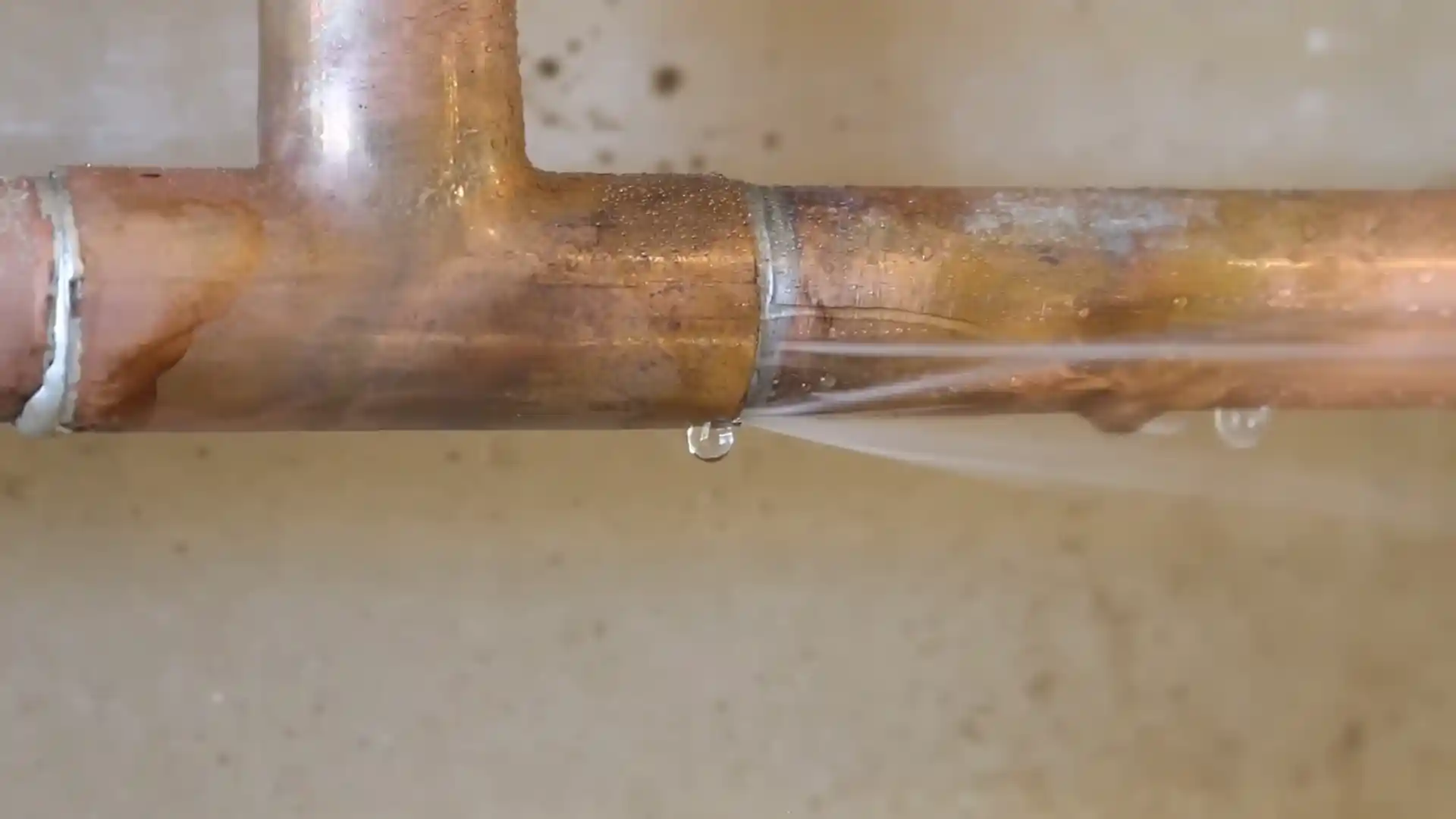
Copper supply lines fail in three distinct chemistry patterns in Parker homes. The dominant pattern is electrochemical pitting from inside the pipe, which produces the classic pinhole leak after 25 to 50 years of service. The second pattern is cold flow at sweated fitting joints, where the solder slowly creeps under continuous water pressure. The third is stress cracking on annealed (soft) copper at the slab penetration point or at fittings near a recently disturbed area.
The Pinery 1970s cohort and the 1990s master-planned phases (Stonegate, Stroh Ranch, Idyllwilde, Canterberry Crossing, Cottonwood Parker) hold most of Parker's copper supply. Parker Water and Sanitation District delivers water at 9.2 grains per gallon, classified as very hard. That hardness is the primary chemistry driver behind the pinhole-failure clock. Call (303) 552-3896 for diagnostic dispatch.
How We Detect Copper Pipe Leak Detection and Repair in Parker, CO
Detection on copper supply varies by which failure mode is suspected.
Electrochemical pinhole detection uses acoustic listening as the primary tool. The pressurized leak signature at a pinhole is consistent and audible through drywall, tile, and most ceiling finishes. Thermal imaging confirms hot-water-side pinholes through the temperature differential. Most Parker pinhole calls locate the leak within 25 minutes of arrival.
Cold-flow joint detection looks for slow staining or moisture accumulation at sweated fittings rather than pressurized hissing. Cold flow leaks are smaller and slower than pinhole leaks; thermal imaging often picks them up before acoustic does because the moisture pattern is slow and steady. Common at elbows and tee fittings.
Annealed-copper stress cracks usually announce themselves through visible moisture at the leak point rather than through diagnostic listening. Common at slab penetrations on older homes where the original installer used annealed copper for the bend and the slab settled or moved over decades. Visual inspection plus moisture mapping confirms.
Repair path follows the failure mode in Parker, CO
Each failure mode has a corresponding repair approach, and the choice between spot work and repipe depends on the broader copper age and condition.
Pinhole spot repair opens drywall at the leak, cuts the failed section, and sweats a new piece in place. Cost $400 to $1,000 per leak point. Reasonable for a one-off failure on copper under 25 years old.
Section replacement covers a 6 to 20 foot run when multiple pinholes have appeared in the same area or the surrounding pipe is age-equivalent. Cost $800 to $2,400 per section. Common call for The Pinery 1970s homes.
Cold-flow joint repair usually replaces the failed fitting with a new sweat joint or a press-fit equivalent. Cost $300 to $700 per joint. Press-fit fittings are increasingly the preferred replacement because they remove the cold-flow risk entirely.
Whole-house repipe to PEX abandons the existing copper and runs new PEX through walls, ceilings, and crawl spaces to every fixture. Cost $5,500 to $12,000. The standard recommendation for The Pinery 1970s copper at this point, increasingly common in early-1990s Stonegate as that cohort moves through year 30.
Copper cohort math for Parker homes
The Pinery 1970s development holds Parker's oldest copper supply. Those lines are now 45 to 55 years old, well past the typical pinhole-failure window for very hard water. Multiple-pinhole events within 12 to 18 months are routine. Whole-house repipe is usually the right economic call before the third or fourth pinhole accumulates.
The 1990s and early-2000s master-planned phases sit at the 25 to 35 year mark, the mid-pinhole window. First-pinhole events are common; second pinholes within 18 months happen in 30 to 40 percent of homes where the first one appeared. The Pinery and Pine Lane Estates owners face the same failure clock, accelerated by hardness past 17 grains per gallon on some wells.
Mid-2000s and 2010s cohorts (Bradbury Ranch, Lincoln Creek, Reata Ridge, Trails at Crowfoot, Hidden River, Parker Vista, Black Feather) mostly transitioned to PEX supply. Most kept copper stubs at fixtures and copper hot-water connections at the heater. Failures in those cohorts cluster at the copper-PEX transition fittings, not in the copper pipe itself.
Copper pipe detection $250 to $500. Repair $300 to $12,000.
Detection $250 to $500. Repair pricing follows the failure mode and remaining pipe life: pinhole spot $400 to $1,000, section replacement $800 to $2,400, cold-flow joint $300 to $700, whole-house repipe to PEX $5,500 to $12,000.
Green stain or moisture spot on copper?
Pinhole vs cold flow vs stress crack diagnosis on the first visit.
☎ (303) 552-3896Copper pipe leak questions Parker calls in with
Why does copper fail at pinholes specifically?
The chemistry of very hard water against copper creates micro-galvanic cells inside the pipe wall over decades. At certain points (often in flow turbulence near fittings) the cell concentrates and thins the copper from the inside out. The wall eventually perforates as a pin-sized hole. The mechanism is electrochemical, not mechanical, which is why pinholes appear in apparently undamaged pipe.
Should I switch to PEX if I have copper?
Depends on the copper age and the home's leak history. PEX is more durable against hard-water pinhole risk and is the standard new-build material. Whole-house repipe to PEX makes economic sense when the copper is past 30 years and has had at least one pinhole event. For younger copper or copper with no history of leaks, the cost of pre-emptive repipe usually does not pay back.
Are press-fit copper fittings reliable?
Yes, for new work and for repair. Press-fit fittings use a stainless steel ring crimped onto the pipe with a special tool; no flame, no solder, no flux. The fittings are code-approved for residential and commercial water supply across Colorado. They eliminate the cold-flow failure mode that affects traditional soldered joints over decades.
Related Leak Services in Parker, CO
Parker, CO & Douglas County Coverage
Copper supply density tracks the 1970s through 2000s housing eras. Pinery oldest, master-planned next, then 2010s PEX transition.