
Hot Tub Leak Detection & Repair in Parker, CO
Portable hot tubs hide the plumbing inside an insulated cabinet. Pumps, plumbing unions, and internal lines all sit in the foam-filled space around the shell. Diagnosing a hot tub leak means opening cabinet panels and chasing water back to the source through the foam.
Cabinet-access diagnostic.
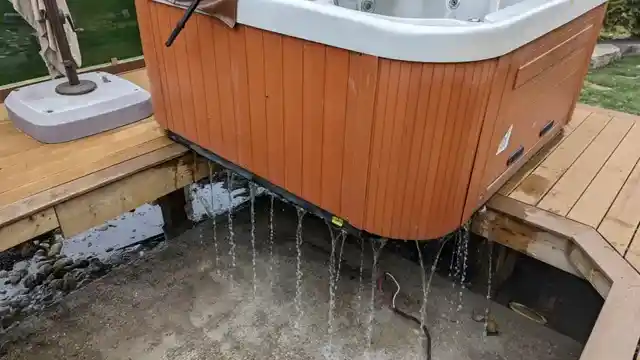
Portable hot tubs are built with a drop-in acrylic shell sitting inside an insulated cabinet. The space between shell and cabinet is filled with spray foam insulation, and the plumbing runs through that foam space. Pumps, heaters, plumbing unions, and internal flex hoses are all hidden behind cabinet panels. When a hot tub leaks, the water travels through the foam before showing at the cabinet base, which obscures the actual source.
Diagnostic work on portable hot tubs requires removing cabinet panels and methodically tracing water back through the foam to the source. Most leak calls in Parker resolve at one of three common sources: a pump union or seal, a flex hose connection at the shell, or a fitting at a jet body. The shell itself rarely fails; cabinet-side hot tubs use modern acrylic that holds up well for 18-plus years. Call (303) 552-3896 for dispatch.
How We Detect Hot Tub Leak Detection and Repair in Parker, CO
Detection on a portable hot tub runs three passes after the cabinet panels come off. Most leaks resolve at the first.
Cabinet base inspection identifies where water is exiting the cabinet. The base is usually the first sign of an internal leak. We map the wet area and look for staining or drip patterns. The water has often traveled some distance through the foam, so the cabinet exit point is rarely directly under the actual leak.
Pump pack and union inspection covers the main pump pack inside the cabinet. The pump seal, the union fittings on each side of the pump, the heater inlet and outlet, and the control pack connections are all candidates. Visual inspection during a partial-fill test usually identifies pump-side leaks quickly.
Flex hose tracing follows the plumbing from pump back to the shell. Hot tubs use flexible plumbing hose to navigate the foam-filled cabinet space. Hose-end fittings at the shell penetrations are the second-most-common leak source after pump union failures. We trace each hose run with a flashlight, looking for moisture, staining, or active drip.
Jet body and shell fitting check happens last. Jet bodies use threaded gaskets similar to built-in spas. Failed gaskets show during a dye trace from the spa side. Shell-side fittings (skimmer, suction, return) get inspected at their penetration points through the shell.
Some portable hot tubs allow full cabinet removal for major repairs; others need to be repaired in place through the access panels.
Repair scope inside the cabinet in Parker, CO
Hot tub repairs work inside the cabinet, often in tight spaces. Most repairs are component swaps rather than rebuilds.
Pump union or seal replacement swaps the failed component. Pump seals require pulling the pump partially out of position for access. Cost $200 to $500 depending on pump type and accessibility.
Flex hose replacement swaps the failed hose end-to-end or just the affected fitting. Cost $150 to $400 depending on length and access route.
Jet body gasket replacement on hot tubs that allow access to the shell side from the cabinet. Cost $100 to $300 per gasket.
Pump pack replacement on units with major pump failure. New pump packs (1.5 to 2 HP single or two-speed) install with the existing plumbing connections in most cases. Cost $700 to $1,500 installed.
Heater element or control pack replacement on electrical-side failures. Cost $250 to $900 depending on component.
Foam-removal repair on leaks that require digging through the cabinet foam to access the failed component. The foam gets removed in the affected area, the repair completed, and the foam re-sprayed afterward. Cost adds $200 to $600 to the underlying repair scope.
Full hot tub replacement on units past 15 to 20 years with multiple system failures. New hot tubs in the standard 4-to-6 person size install for $5,500 to $14,000 depending on brand and feature set.
Hot tub patterns in Parker
Portable hot tubs concentrate in equestrian outskirts (Franktown, Sedalia, Elizabeth) and in larger-lot master-planned homes where there is room on a deck or patio for a freestanding unit. Some master-planned cohort homes also have hot tubs as a less-expensive alternative to built-in pool spas. Newer builds in Bradbury Ranch, Lincoln Creek, and Trails at Crowfoot are designed with outdoor living spaces that accommodate them.
Parker Water and Sanitation District hardness at 9.2 grains per gallon causes scale buildup on hot tub heater elements faster than on pool heaters because hot tubs operate at higher temperatures. Annual descaling or heater element replacement is more common in Parker than in soft-water markets.
Front Range winters at Parker's elevation put real strain on hot tub systems. January lows of 13 to 22 degrees plus single-digit cold snaps require the hot tub to maintain full operating temperature continuously or risk freeze damage. Most hot tubs in Parker run year-round; complete winterization-and-storage of a hot tub is uncommon and tricky.
Hot tub leak repair $100 to $14,000.
Detection $250 to $500. Repair pricing: jet gasket $100 to $300, flex hose $150 to $400, pump union or seal $200 to $500. Heater or control pack $250 to $900. Pump pack replacement $700 to $1,500. Foam-removal repair adds $200 to $600. Full hot tub replacement $5,500 to $14,000.
Water at the base of your hot tub?
Cabinet-access diagnostic traces the leak back through the foam.
☎ (303) 552-3896Hot tub leak questions Parker calls in with
Why is the leak showing in a different spot from the actual source?
The spray foam insulation between shell and cabinet acts as a sponge and a directional barrier. Water from an internal leak travels through the foam following the path of least resistance, which often means migrating several feet before exiting through the cabinet base. The visible exit point can be quite far from the actual source. Tracing back through the foam during diagnostic work is what locates the real leak.
Can I drain my hot tub in winter to avoid using it for a few months?
Possible but risky in Parker's climate. Hot tubs that get fully drained for the winter need complete blowout of all plumbing lines, removal of standing water from pump pack and heater, and disconnect of electrical supply. Improper winterization combined with single-digit cold snaps usually produces freeze damage to pumps, heaters, and plumbing fittings. Year-round operation at full temperature is the safer approach for the equipment.
How long should a hot tub last in Parker?
Standard portable hot tubs last 12 to 18 years with normal use and proper maintenance. Premium models with stainless-steel jet bodies and higher-grade pumps can hit 20-plus years. Critical maintenance items in Parker include annual chemistry balancing, regular filter cleaning, descaling of heater elements every 1 to 2 years on PWSD water, and proper winterization or year-round-temperature operation.
Related Leak Services in Parker, CO
Parker, CO & Douglas County Coverage
Hot tub density concentrates in equestrian outskirts and larger-lot master-planned communities.