
Above Ground Pool Leak Detection & Repair in Parker, CO
Above ground pools fail differently from inground. A vinyl liner draped over a steel or resin frame has its own failure points: the top rail seam, the wall-to-floor joint, the skimmer mounting bracket, and the return jet fittings. Repairs are mostly liner work.
Liner patch on-site.
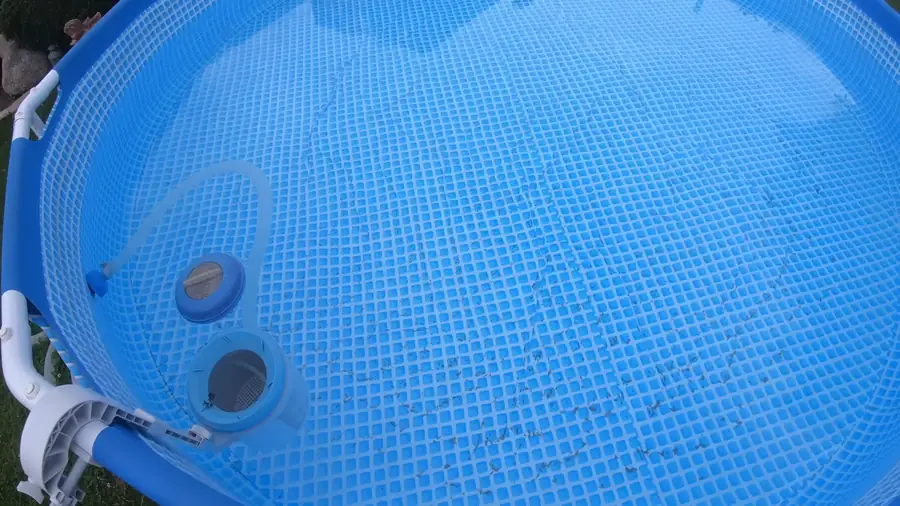
Above ground pools in Parker sit on a steel or resin frame with a vinyl liner draped over the wall and floor. The construction creates specific failure points that inground pools do not share. The top rail where the liner clips over the frame. The wall-to-floor seam where the liner changes direction. The skimmer mounting bracket bolted through the wall. The return jet fittings, also bolted through the wall. The ladder anchor area, where repeated stress creates micro-tears in the liner.
Detection on these pools focuses on the liner because almost every above ground pool leak is a liner leak. The frame itself rarely fails structurally; the steel walls hold their shape for decades when properly maintained. The vinyl liner has a service life of 8 to 15 years depending on UV exposure and chemistry balance. Call (303) 552-3896 for dispatch.
How We Detect Above Ground Pool Leak Detection and Repair in Parker, CO
Above ground pool detection runs three liner-focused tests. Most calls resolve at the first.
Underwater visual inspection with goggles and a snorkel locates most liner punctures and tears. Liner damage shows as a small flap, a pinhole tear, or a visible split. Common spots include the area near the ladder, around the skimmer face plate, and along the floor where furniture or pool toys may have shifted on the bottom.
Dye injection at suspected leak points confirms small punctures that visual inspection alone cannot pinpoint. Food coloring or commercial pool leak dye gets injected near the suspect location while the pump is off and the water is still. The dye gets pulled toward any active leak and shows the path. Most above ground liner punctures locate within 5 to 15 minutes using this method.
Fitting and seam inspection covers the four bolted penetrations through the wall (skimmer, returns, and any light niche) plus the wall-to-floor seam. Failed gaskets at the bolted penetrations are common; the rubber gaskets harden and compress over 8 to 12 years and start seeping. The wall-to-floor seam fails on older pools when the liner has stretched past its limit.
Water-level testing over 24 to 48 hours sometimes runs when the leak rate is slow and the source is not immediately obvious. We mark the water level, measure precisely, and compare against evaporation rates the next day.
Repair scope on above ground pools in Parker, CO
Most above ground pool repairs are liner patches or fitting gasket swaps. Major repairs sometimes mean full liner replacement.
Underwater patch kit application handles small punctures and tears (under 2 inches). The patch material bonds to the wet vinyl while the pool stays full. Cost runs $80 to $250 including the patch kit and labor. Most punctures repaired this way hold for the remaining life of the liner.
Fitting gasket replacement covers the skimmer mount, return jet fittings, and light niche gaskets. The pool stays mostly full; we drain to just below the affected fitting, replace the gasket, and refill. Cost $150 to $400 per fitting depending on location and access.
Larger patch on accessible tear with the pool partially drained handles 2-to-6-inch tears and seam failures. Drain to just below the tear, dry the area, apply a larger patch or liner repair kit. Cost $250 to $600.
Full liner replacement covers liners past 10 to 12 years with multiple failure points or significant fading. The pool gets drained, the old liner removed, the frame inspected and repaired as needed, and a new liner installed. Cost $1,500 to $3,500 for a standard 24-foot round above ground pool, more for larger or oval pools.
Frame repair on rare structural failures (rusted steel posts, cracked resin uprights) runs $400 to $1,500 depending on which components need replacement. Most pools needing frame repair are also approaching liner replacement, so the work often happens together.
Above ground pool patterns in Parker
Above ground pools concentrate in older Parker neighborhoods (Pinery, Mainstreet, pre-1990 Downtown Parker) and on smaller lots where inground installation is impractical or budget-constrained. Master-planned cohorts (Stonegate, Stroh Ranch, Idyllwilde, Cottonwood Parker) lean heavily toward inground installations, so above ground prevalence there is lower.
Front Range UV exposure is intense at Parker's elevation of 5,869 feet. Above ground liners exposed to direct sunlight degrade faster than national averages, with typical service life of 8 to 12 years versus 12 to 18 in lower-UV markets. Liners with covers when not in use can extend that life by 25 to 40 percent.
Parker Water and Sanitation District hardness at 9.2 grains per gallon contributes to scale buildup on fittings and skimmer assemblies. The scale itself does not cause leaks, but it can mask early gasket failures by mineralizing over small seeps until they grow into larger leaks.
Front Range freeze cycling matters more for above ground pool plumbing than for the pool itself. Pumps, filters, and exposed plumbing on the equipment pad freeze and split when not properly winterized. Most leak calls in spring trace back to inadequate winterization the prior fall.
Above ground pool leak repair $80 to $3,500.
Detection $200 to $400. Repair pricing: underwater patch $80 to $250, fitting gasket $150 to $400, larger accessible patch $250 to $600, full liner replacement $1,500 to $3,500, frame repair $400 to $1,500.
Water dropping faster than evaporation?
Liner-focused diagnostic, often patched same visit while the pool stays full.
☎ (303) 552-3896Above ground pool questions Parker calls in with
How long should an above ground pool liner last in Parker?
Typical liner life on Front Range pools at Parker's elevation runs 8 to 12 years with normal use. The high-UV environment at 5,869 feet shortens liner life compared to lower elevations. Liners with covers when not in use, balanced water chemistry, and proper winterization can hit 15 years. Pools left uncovered all summer and improperly winterized may need a liner at year 6 to 8.
Can the pool stay full while you fix the leak?
For most underwater patches and small fitting work, yes. The underwater patch kits we use bond to wet vinyl and cure in place. Fitting gasket replacement on the skimmer or returns requires draining to just below the affected fitting, but not full pool drain. Full liner replacement is the only common scope that requires fully draining the pool.
My pool is 15 years old and leaking. Patch or replace the liner?
Usually replace at that age. A liner past 12 years has visible fading, possible micro-cracks, and is statistically near end of life across all parts of the surface. Patching one location often produces a second leak elsewhere within months. Replacement at year 12-15 is generally the better economic call. Pools past 18 years sometimes have frame issues as well that should be addressed during the relining.
Related Leak Services in Parker, CO
Parker, CO & Douglas County Coverage
Above ground pools concentrate in older neighborhoods and smaller lots. Master-planned cohorts lean inground.